
This Saturday, 25th October, sees the return of the oldest international competition across both codes of Rugby, where a trophy was contested for, as the Rugby League Ashes series will be contested after a 22-year hiatus.
Personally speaking, I’ve lost count of the amount of times friends or family members have ‘corrected’ me mid-sentence that the Ashes is Cricket. Its hard to argue with that way of thinking, in fairness. The Cricket Ashes is far more well known and, perhaps most importantly its been contested without a large break since its inception in 1882.
In contrast, the Rugby League Ashes had, to all intents and purposes, seemingly disappeared along with the Great Britain team in the mid-noughties. For some of us, the only Ashes series we can vividly still remember were those contested at the start of the millennium.
To date there have been 39 editions of the Rugby League Ashes played. Australia lead the aggregated series score 20-19.
Of course, one article alone cannot hope to cover every controversy, great player, golden moment and anecdote throughout this competition. Instead, treat this as a flavour to the full story of this incredible 117-year rivalry.
1908-9: The Birth of the Ashes.
The first Australian touring side arrived in England on 27 September 1908, they toured Britain, losing more games than they won. At the time, the hosts played under the banner of the ‘Northern Union’ – in tribute to the great rugby split of 1895 between the clubs in the north and south of England.
The tour is more remembered for the terrible mid-winter weather, and the saga of the Australian jerseys. Each touring player was given a total of one jersey each – a sky-blue and maroon hooped pattern (reflecting the colours of New South Wales and Queensland states respectively). The jerseys would only be worn for the opening tour match. Played out in relentless freezing rain, made of heavy wool, most of the jerseys had considerably shrunk by the following day – when they were due to play their next tour match. According to ‘The Times’ the touring party “traversed the length and breadth of the city (London), begging clubs for something to attire themselves with”.
Eventually one club, located near Hammersmith, kindly loaned the tourists their jerseys – bottle green with two gold Vs on the front – for the duration of the tour. The Kangaroos continue to use the same pattern on their jerseys today.
They played their first ever test against the Northern Union in December at Loftus Road, London; a last minute penalty against the Kangaroos for an obstruction play handed England a goal and a 22-all draw in front of a crowd of 2,000. The second test in Newcastle in January 1909 attracted a crowd of 22,000, and the Northern Union won 15–5. The third test was played at Villa Park, Birmingham, with the hosts winning again 6–5 before a crowd of 9,000. At the conclusion of the final game, during the trophy presentation to the victorious hosts, the Australian captain allegedly suggested that the series should be named “the Ashes” after the cricket series of the same name. The name, just like the story, stuck.

1970 – Great Britain’s Last Triumph
The 1970 Great Britain Lions tour was the Great Britain national rugby league team’s 14th tour of Australia and New Zealand and took place from May to August 1970. A total of 24 matches were played against local club and representative sides during the tour, including a three match test series against the Kangaroos and a two match series against the Kiwis. Great Britain were victorious in both series, winning with 2-1 and 2-0 scorelines respectively.
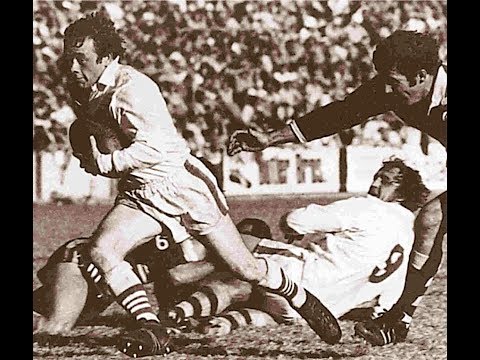
The tour was one of the most successful in Lions history, with the team winning all but two of the matches. It is also remembered for being the last time that Great Britain won an Ashes series against Australia. It was also notable for providing the sport with one of its most iconic ‘David versus Goliath’ moments. Roger Millward, standing all of 5ft 4ins and only 65kg wet-through, would play the decisive part for the Lions.
Having been overlooked for the first Test against the Australians, the Lions team were heavily beaten 37–15 and wholesale changes were made for the 2nd Test. Millward was drafted into the side where he gave, according to the Sydney Morning Herald match report, “a terrorising performance, single handedly squaring the series” scoring 20 points (2 tries, 7 goals) in a 28–7 win to square the series. The third Test decider was also successful and the Ashes regained. The 21–17 score did not reflect Great Britain’s superiority as they scored five tries to one, but were heavily penalised by the referee. Again, Millward rose to the occasion as: with approximately five-minutes to go he scored the match and series winning try on the Sydney Cricket Ground. The try resulted “from a thrust through the middle by the second rows, first by Jimmy Thompson, and then a bust by Doug Laughton, who then delivered a brilliant pass to Millward in space; Millward took the pass at pace and in turn then outstripped the opposition defence in an arcing run of over 40-yards to score.”
2003 – Coaching Controversy and a Kangaroo Clean Sweep
In February 2001, David Waite was named as the first full-time head coach of Great Britain ahead of the Ashes series that year. The appointment was considered highly controversial by a large number of British fans, on the grounds that Waite was an Australian. The RFL, conscious not to see the national side become embroiled in off-field wars with Super League clubs as it had throughout the late 1990s, heavily emphasised their belief that Waite was considered among “the best in class” candidates.
The Australians arrived in Britain for the first Ashes series since 1994, and the hosts surprised everyone by narrowly winning the first test, before comprehensively losing the next two. The controversy reared its head again the following year when Great Britain suffered its heaviest defeat to Australia (64-10) in Sydney.
In November 2003 Great Britain lost an Ashes series 0–3 on home soil. This is not to say it was a walkover as the hosts led all three matches with less than five minutes to play. A moment of brilliance from Australia sealed the first game, a sequence of ill-discipline from the hosts in the second encounter, and a case of a comeback too-little-too-late in the final match being the causes. Three excruciating defeats, that could have been victories, were bad enough on their own. It was made even more painful by the fact that England’s Rugby Union team were completing their world cup triumph against Australia at the same time.
Nevertheless the 0-3 scoreline could not be ignored. It was considered one of the most humiliating defeats in Great Britain Test history, as with injuries and pullouts Australia had, many journalists argued, sent over a third-choice side. For the Lions, who had been so heavily favoured to win the series, this was too far. Waite stepped down from his role in the immediate aftermath.
The Ashes have since been uncontested for 22 years. Until now…

 A View From The Stands
Leave a comment